I loved him.
Not quietly.
Not reasonably.
I loved him the way only young people love when they still don’t know the price of a choice.
He wanted to marry me.
He said he would find work closer to Tarnovo. That we would build our life together.
But my father was against him.
He said Todor wasn’t reliable. That he had no property. That he didn’t have a permanent job. That he wouldn’t make me happy.
And I was afraid.
Not of Todor.
Of disappointing everyone.
Georgi proposed.
He had a ring.
He had an apartment.
He had a job.
He had my family’s approval.
And I said yes.
Not because I didn’t love Todor.
But because I was too afraid to choose love over security.
Todor left.
He didn’t make a scene.
He didn’t beg me.
He simply said:
“If you ever decide you want a life instead of comfort, you’ll know where to find me.”
Then he left for the Rhodopes.
Three months later, I married Georgi.
My children always knew that part of the story.
They knew my marriage to their father was good.
And it was.
Georgi loved me in his own way.
He was thoughtful. Hardworking. Patient. He never raised his voice. He never made me feel alone.
When Silvia was born, he cried more than I did.
When Mikhail was born, he stood outside the maternity ward with a bouquet of carnations and told everyone that his son would become an engineer.
We built a life.
Not a fairy tale.
But a life.
And when Georgi died of a heart attack at fifty-nine, I thought part of me had died with him.
I was thirty-three.
I had two small children.
Silvia was seven.
Mikhail was four.
From that day forward, I never thought about another love.
Not because I didn’t have opportunities.
But because I had no strength left.
I worked.
I raised you.
I educated you.
I paid the bills.
I fought to give you an education, a home, and security.
The years passed.
You grew up.
You got married.
You had children of your own.
I remained alone in the big house.
Sometimes it was quiet.
Very quiet.
But I wasn’t unhappy.
Or at least, that’s what I thought.
Silvia stared at me with wide eyes.
“What does any of this have to do with the baby?” she asked.
I looked at Todor.
He sat quietly in the last row, his cane between his knees.
“He found me two years ago.”
A murmur passed through the courtroom.
“How?” the judge asked.
“Through an old friend from high school. He saw a photograph from a reunion. He asked about me. He learned that I was a widow. He found my address.”
Mikhail laughed nervously.
“And what? After fifty years, he simply knocked on your door and you decided to have a baby?”
“It wasn’t like that.”
“Then what was it like?”
He spoke angrily.
But beneath his anger, I heard panic.
He didn’t want to know.
Because if he knew, he would have to admit that I wasn’t some confused elderly woman.
I was a person with my own life.
My own history.
My own right to choose.
“The first time Todor came, I didn’t let him in,” I continued. “I stood behind the door and cried. Not because I didn’t want to see him. But because I was afraid I would see how much time had passed.”
“And then?” Silvia asked quietly.
“Then we met at a café. We talked for three hours. Then four. Then all day.”
Todor smiled faintly.
“She still ordered coffee without sugar,” he said.
For a moment, I felt something warm.
Then I looked at my children.
And the warmth disappeared.
“We didn’t plan anything,” I said. “We didn’t plan to get married. We didn’t plan to have a child. We simply… found our way back to each other.”
“At seventy-nine?” Silvia whispered.
“At seventy-nine, I’m still alive, Silvia.”
She recoiled as if my words had struck her.
“I’m not saying you’re not alive.”
“Then why do you speak about me as if I’m a piece of furniture that needs to be put away when it gets too old?”
The judge didn’t interrupt me.
“You said the child is biologically yours,” he noted.
My lawyer stood.
“Yes, Your Honor. Mrs. Mileva and Mr. Stoyanov used a legally performed medical procedure abroad, involving an egg that Mrs. Mileva had preserved many years ago for personal reasons. The pregnancy was carried by a surrogate under a contract arranged according to the laws of that country. There is complete medical and legal documentation.”
The courtroom erupted in noise.
Silvia covered her mouth.
Mikhail slammed his hand on the table.
“This is insane!”
The judge raised his voice.
“Order in the courtroom!”
Emilia moved.
I began rocking her gently.
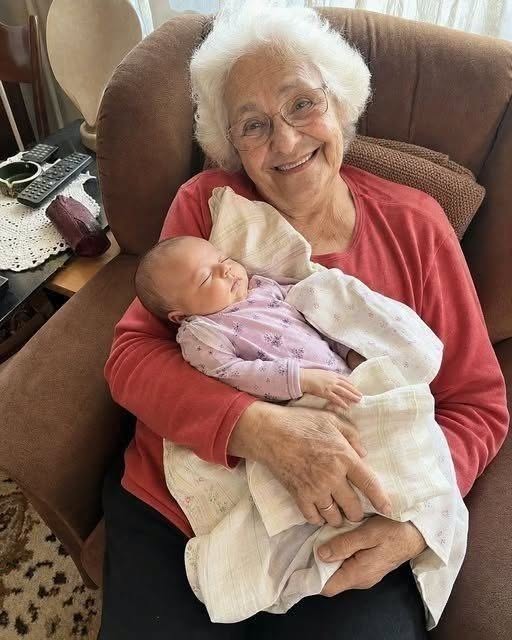
She was so small.
And all around her, adults were shouting, arguing, and trying to decide whether she had a right to exist.
“I don’t owe you an explanation for every step of my personal life,” I said. “But I owe you the truth because you are my children. And the truth is that I wasn’t deceived. I wasn’t forced. I wasn’t confused. I made this decision after months of medical consultations, conversations with Todor, lawyers, and specialists.”
“You’re seventy-nine!” Mikhail shouted.
“Yes.”
“She’ll be twenty when you’re almost a hundred!”
“And you’ll be fifty-three when she’s twenty. That doesn’t make you incapable of being her brother.”
He stared at me.
“I’m not her brother.”
“By blood, you are.”
“That means nothing.”
Tears ran down my face.
Not because his words surprised me.
But because they confirmed what I had understood the day I told them about the pregnancy.
They weren’t afraid for me.
They were afraid for themselves.
Six months earlier, I had invited Silvia and Mikhail to lunch.
I prepared their favorite dishes.
Stuffed peppers for Silvia.
Homemade moussaka for Mikhail.
I had bought a strawberry cake because the grandchildren were coming later.
Todor was in Ruse at the time. I still wasn’t ready to tell them about him.
We sat around the dining-room table.
Silvia was telling me about her work. Mikhail was complaining about some renovation at the office.
I looked at my children and thought about how much they had grown.
Then I said:
“I have something to tell you.”
They fell silent.
“I’m pregnant.”
At first, they thought I was joking.
Then they saw my face.
Silvia laughed nervously.
“Mom, that’s not funny.”
“I’m not joking.”
Mikhail went pale.
“What does that mean?”
“It means I’m expecting a child.”
Silvia began to cry.
Not from happiness.
“Are you sick? Is someone blackmailing you? Has someone deceived you?”
“No.”
“Who is the man?”
“I’ll tell you when the time is right.”
“There is no ‘right time.’ This has to be stopped,” Mikhail said.
At that moment, I realized they weren’t talking about me.
They were talking about the inconvenience.
About people.
About what the family name would look like.
“I’m not ending the pregnancy,” I said.
“You can’t do this!” Silvia shouted.
“I already am.”
After that, the phone calls began.
First every day.
Then several times a day.
“Think about your health.”
“Think about what people will say.”
“Think about us.”
But the words “think about us” gradually began to mean something else.
Mikhail asked whether I had changed my will.
Silvia asked whether Todor had any rights to my properties.
Then I learned that they had gone to a notary to ask how they could have me placed under legal guardianship.