“And the house?”
“I’ll be there tonight.”
“I’ll arrange a deputy to accompany the process server. Not because you need protection,” he added, “but because men like Warren behave better in front of witnesses.”
“They behave differently,” I said. “Not better.”
Rowan gave a dry little laugh. “Fair enough.”
The third call was not to anyone in my family.
It was to my commanding officer.
I kept it brief. I informed him that a domestic legal matter might expose my rank and public biography. Nothing classified. Nothing operational. But enough that I wanted the chain of command aware before Warren attempted to turn embarrassment into accusation.
When I finished, he said, “Colonel, do you require assistance?”
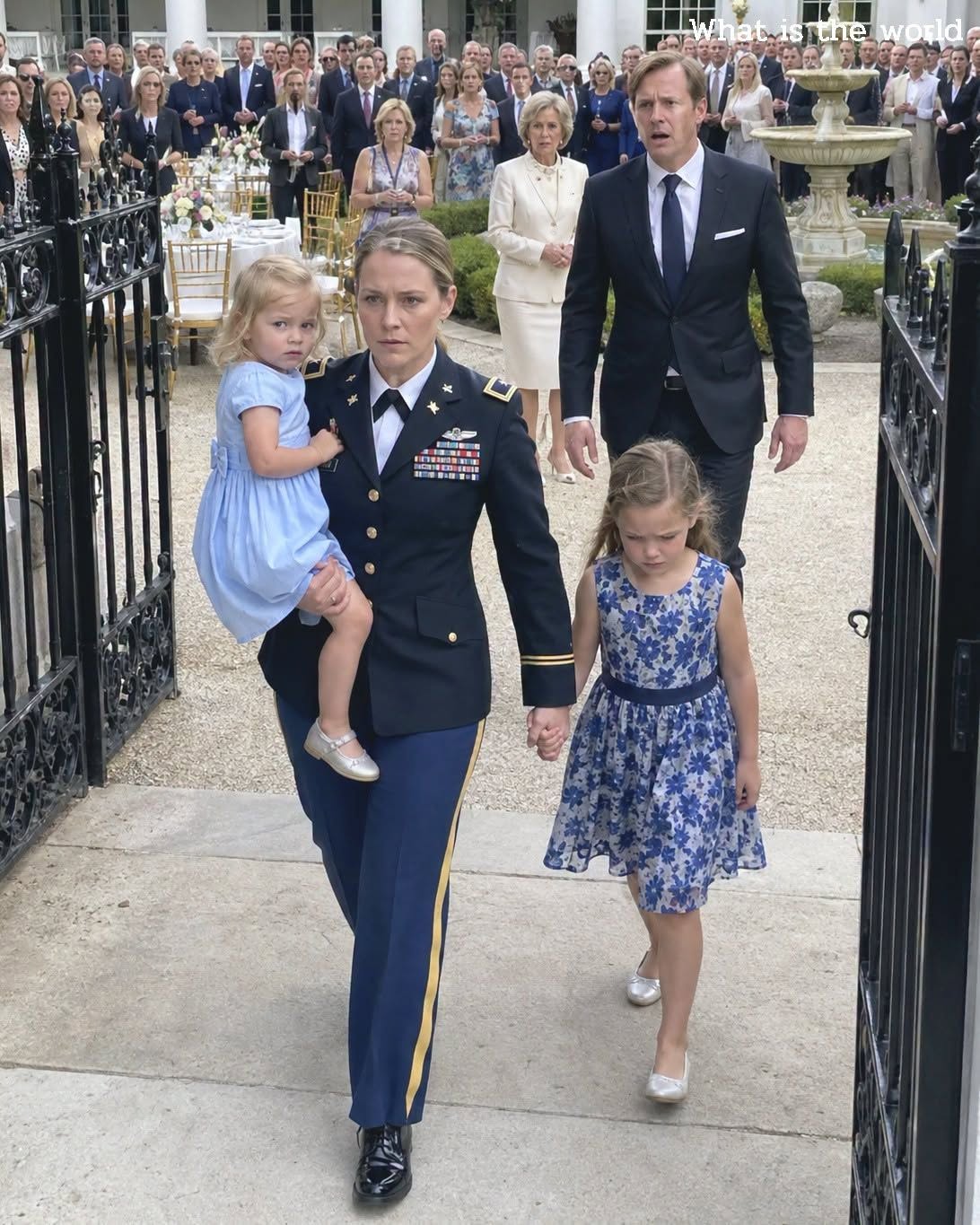
I looked at my daughters through the glass again.
“No, sir,” I said. “I require a record.”
“You’ll have one.”
By the time I returned to the booth, June had whipped cream on her nose and Sadie had color in her cheeks again.
For twenty minutes, I let them be children.
At the estate, Warren was still playing king.
I learned that later from three different guests, two videos sent anonymously, and one cousin who suddenly remembered she had always admired me.
Apparently, after I left, Warren laughed too loudly and told everyone I was “sensitive.”
Beverly made a small performance of sighing near the family table.
“Some women never learn how to fit into a family,” she announced, loud enough for the nearest guests to hear. “A wife should understand her place.”
Warren raised his glass again.
“To family,” he said.
The guests echoed him.
“To family.”
Then the first server approached him with a folded envelope.
Warren waved him away. “Not now.”
The server remained. “Sir, the estate manager asked me to give this to you immediately.”
Warren snatched it, annoyed. Beverly leaned close.
“What is it?”
He opened the envelope.
According to the video, his smile lasted seven seconds.
Then it fell apart.
The letter was simple.
Aster Hall was not owned by Warren Caldwell.
It had never been owned by Warren Caldwell.
It belonged to the Hale Granddaughters Trust, established for the benefit of Sadie Elizabeth Caldwell and June Margaret Caldwell, with Allison Hale Caldwell serving as trustee until both children reached legal age.
Warren had been granted a one-day event license under strict conditions.
He was not permitted to claim ownership.
He was not permitted to use the estate as collateral.
He was not permitted to represent the property as part of his personal assets.
Any violation triggered immediate termination of the license, full financial liability for the event, and enforcement of the personal guarantee he had signed while begging my parents for a three-hundred-thousand-dollar investment.
There had never been an investment.
Only paperwork Warren had been too arrogant to read.
By the time he finished the first page, the second envelope arrived.
This one was carried by a process server in a gray suit.
The quartet stopped playing.
The fountain kept running.
A hundred guests watched Warren Caldwell’s greatest achievement dissolve in his hands.
“You can’t serve me at my own party,” Warren snapped.
The process server glanced at the columns, the gardens, the catered tents, and the guests holding crystal glasses.
“This is not your property, Mr. Caldwell.”
Someone gasped.
Someone else whispered, “What?”
Beverly rose from her chair. “How dare you speak to my son like that?”
The estate manager stepped forward then. Mr. Devereaux was seventy years old, elegant, precise, and entirely unmoved by wealthy tantrums.
“Mrs. Caldwell,” he said to Beverly, “your son was informed in writing that any false claim of ownership would terminate today’s event.”
Beverly laughed once. “False claim? Warren bought this estate.”
“No,” Mr. Devereaux said. “He did not.”
Warren’s brother stood. “Then who owns it?”
The manager adjusted his glasses.
“The beneficiaries are Sadie and June Caldwell.”
For the first time that afternoon, Beverly had nothing to say.
The family table went silent.
The same table where my daughters had not been welcome.
The same table Beverly had said was for women who gave the family sons.
It belonged, in every legal and practical sense, to two little girls who had been fed scraps at its edge.
The video shook slightly then, because whoever was recording had started laughing under their breath.
Warren turned red. “This is Allison’s doing.”
The process server handed him another packet. “This is also for you.”
That packet contained the personal guarantee.
Three hundred thousand dollars, payable upon breach.
An additional clause for reputational harm and fraudulent representation.
Another for unpaid event expenses.
Another for unauthorized use of trust property in business solicitations.
Because Warren had not merely told relatives he owned Aster Hall.
He had told investors.
He had told creditors.
He had told a private lender that the estate would soon be refinanced to support his failing development company.
He had built an empire out of borrowed suits, leased vehicles, and lies printed on thick paper.
Now the paper was answering back.
Beverly grabbed the packet from his hand and scanned it, her mouth tightening with each line.
“This is nonsense,” she said. “Allison doesn’t have money like this.”
My father stepped out from beneath the portico.
He had not been invited to the celebration.
He had come anyway.
Tall, silver-haired, dressed in a dark suit with no need for decoration, he walked across the lawn with my mother beside him. People moved out of their way without understanding why.
Warren saw him and paled.
“Tom,” he said, suddenly much quieter.
My father did not look at him.
He looked at the table. At the plates. At the untouched wine. At the cracked plastic container still sitting near the edge of the lawn where Beverly had left it.
Then he looked at Beverly.
“My granddaughters ate from that?” he asked.
No one answered.
He walked to the container, picked it up, and held it as if it were evidence.
Which, in a way, it was.