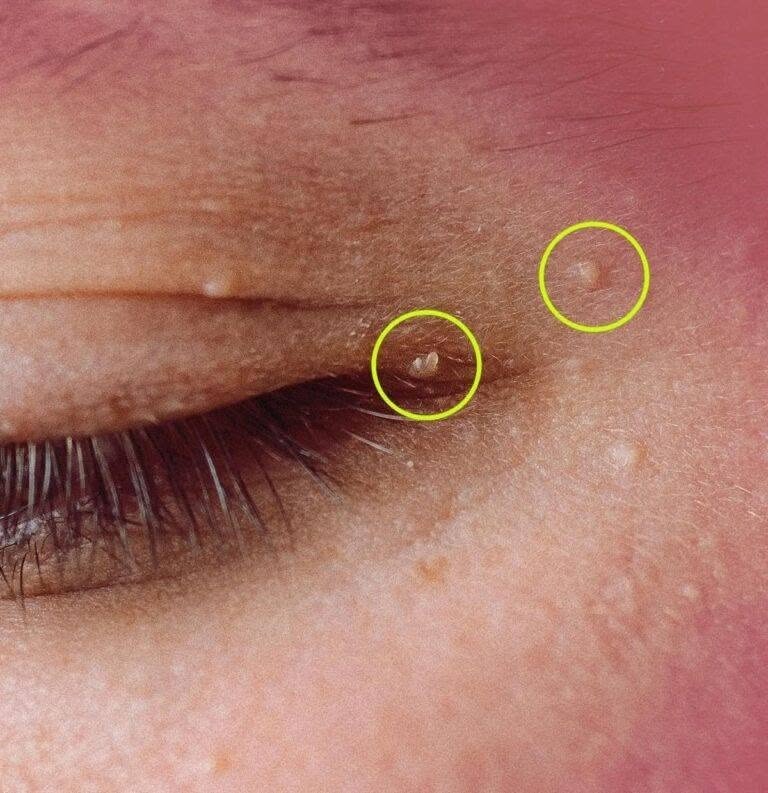
In most cases, no.
Ordinary milia are benign and are generally a cosmetic issue rather than a health problem.
They don’t usually require treatment.
Some disappear naturally.
Others—particularly in adults—can remain noticeable for considerably longer.
If the bumps bother you cosmetically or you’re uncertain whether they’re actually milia, a dermatologist can examine them.
That’s particularly useful because several other skin conditions can sometimes produce small bumps that resemble milia.
What Causes Milia?
There isn’t one single cause that applies to every person.
Primary milia can appear without an obvious preceding skin problem.
Other forms can develop after the skin has been damaged or injured. DermNet notes that secondary milia may develop following burns, blistering skin conditions, or other forms of skin injury.
The important point is that milia aren’t simply caused by having a “dirty face.”
Excessive washing therefore isn’t the solution.
In fact, aggressively scrubbing your face in an attempt to remove them may simply irritate your skin.
Can Heavy Skin-Care Products Cause Milia?
This is sometimes discussed as a contributing factor, particularly with very heavy or occlusive products, but the causes of milia can vary.
If you notice that small bumps repeatedly appear after introducing a particularly rich facial or eye product, consider discussing your routine with a dermatologist.
You can also try simplifying your skin-care routine and choosing products that feel appropriate for your skin type.
But don’t automatically blame one moisturizer for every milium.
Do Milia Go Away Naturally?
They can.
Many cases don’t require treatment at all.
Cleveland Clinic notes that milia can disappear without treatment, although the amount of time they remain can vary.
This means that if you have a few small bumps that aren’t causing any discomfort, simply leaving them alone is a perfectly reasonable option.
Treatment is usually pursued because someone doesn’t like their appearance rather than because the milia are dangerous.
The Biggest Mistake: Trying to Pop Milia
When people discover a tiny white bump, their first instinct is often:
“I’ll just squeeze it.”
Don’t.
A milium isn’t sitting inside a pore waiting to be popped like an ordinary pimple.
The material is trapped beneath the skin.
Repeated squeezing can damage the surrounding tissue without actually removing the cyst.
Cleveland Clinic specifically advises against trying to squeeze or scrape milia at home because doing so can cause infection or scarring.
This warning becomes even more important around the eyes.
Never start experimenting with needles or blades near your eyelids.
What About Using a Needle at Home?
Professional removal sometimes involves carefully opening the surface and extracting the keratin.
That doesn’t mean you should reproduce the procedure yourself.
Dermatologists have appropriate equipment, lighting, sterile technique, and knowledge of skin anatomy.
At home, it’s easy to puncture too deeply, introduce bacteria, cause bleeding, create a scar, or injure delicate tissue.
And around the eye, the consequences of an accident can be much more serious.
Leave extraction to an appropriately trained professional.
Can Steam Remove Milia?